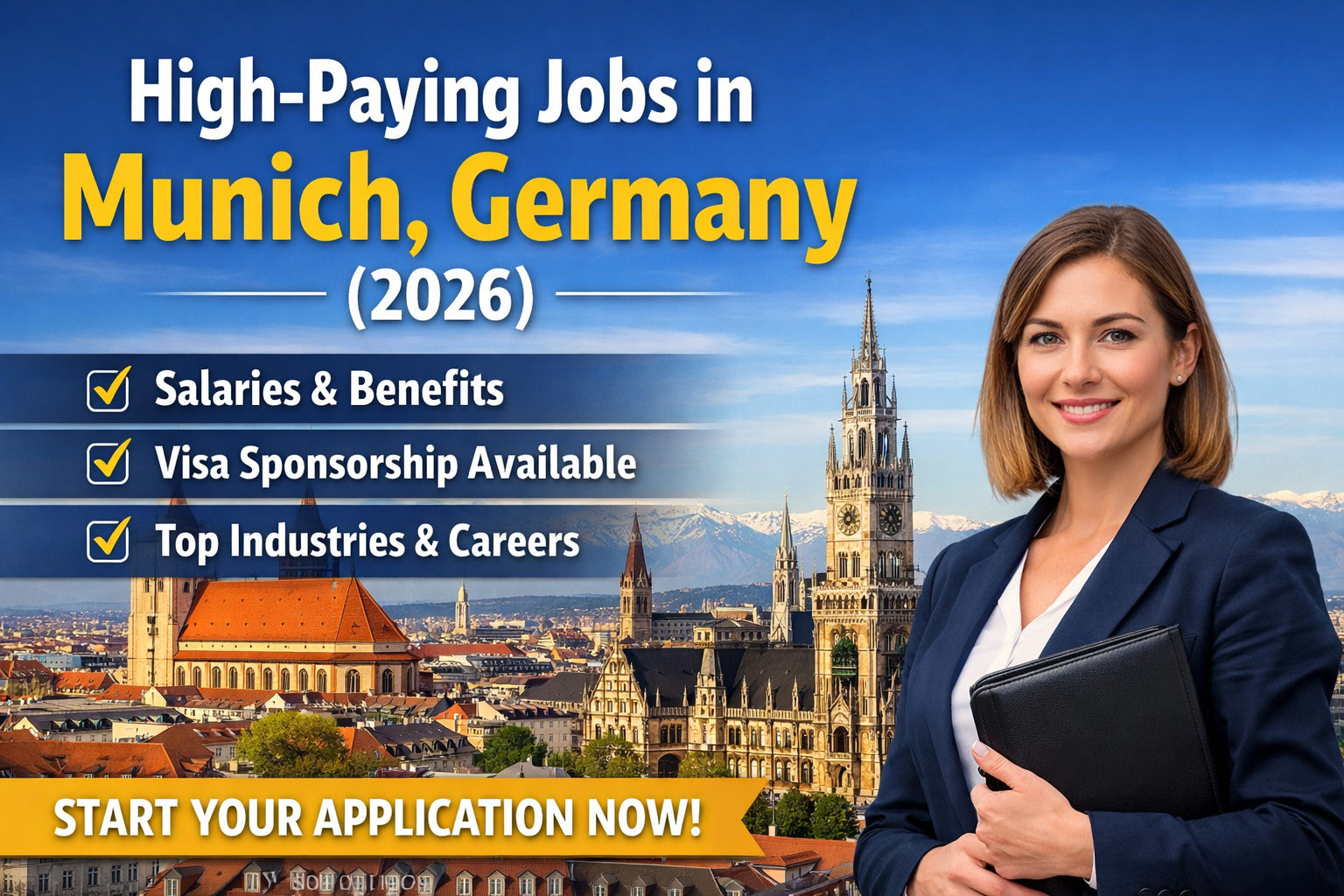
Munich, the capital of Bavaria, is widely seen as Germany’s wealth engine and one of Europe’s strongest business and innovation hubs. With a powerful industrial base, an expanding digital economy, and world-class research institutions, Munich continues to attract both local professionals and international job seekers looking for high salaries, visa sponsorship opportunities, and long-term career growth.
Often referred to as the heart of “Isar Valley,” Munich combines global corporations, high-performing mid-sized companies, and a fast-growing startup scene. For skilled professionals, this creates a job market where career progression is realistic, salaries are competitive, and demand remains strong in high-value sectors such as technology, finance, engineering, and healthcare.
This guide breaks down Munich’s employment landscape, the highest-paying industries, opportunities for expats and English-speaking professionals, visa pathways, salary expectations, cost of living, and practical steps to secure a high-paying job in Munich in 2026 and beyond.
Why Munich Is One of Europe’s Best Cities for High-Income Careers
Munich consistently ranks among Germany’s most resilient labor markets. It typically records low unemployment compared to other major cities, and it benefits from a rare combination of:
Strong corporate headquarters (global employers)
Elite research universities and institutes
High investment in technology and sustainability
Excellent infrastructure and international connectivity
Reliable labor protections and strong benefits
Munich’s economic strength is driven by major employers such as BMW, Siemens, Allianz, Munich Re, MAN, Infineon Technologies, and many advanced suppliers and service firms supporting these ecosystems.
Munich’s Economic Role in Germany
Munich contributes significantly to Germany’s overall economic output and is often considered a national leader in innovation and high-value employment. Its economy is built around sectors that typically pay above-average salaries, including:
Automotive and advanced manufacturing
Information technology and software
Semiconductors and electronics
Finance, insurance, and consulting
Biotechnology and medical technology
Below is a helpful snapshot of major sectors and typical salary potential.
Key Employers, Workforce Scale, and Salary Ranges
| Sector |
Leading Employer |
Estimated Employees in Munich |
Average Annual Salary (€) |
| Automotive Engineering |
BMW Group |
40,000+ |
70,000 – 120,000 |
| Finance & Insurance |
Allianz SE / Munich Re |
12,000+ |
68,000 – 115,000 |
| Technology & Energy |
Siemens AG |
35,000+ |
65,000 – 110,000 |
| Semiconductors & IT |
Infineon Technologies |
9,000+ |
75,000 – 130,000 |
In addition to big corporations, Munich’s small and medium-sized companies and startups create consistent hiring demand in AI, cybersecurity, cloud infrastructure, renewable energy, and digital finance.
Job Market Trends in Munich (2026 Outlook)
Munich’s job market continues to shift toward digital skills and sustainability-driven growth. Employers are investing heavily in:
Software engineering and cloud systems
Cybersecurity and data protection
AI, automation, and robotics
Green technology and renewable energy
Medical technology and biotech R&D
Risk management, compliance, and financial analytics
As businesses modernize, Munich remains one of the most attractive destinations in Europe for professionals who want high-income careers with international mobility.
Many employers have also become more international, offering:
Flexible work models (remote or hybrid)
Relocation packages (role-dependent)
English-speaking teams (especially in tech and finance)
Support for EU Blue Card and skilled worker visas
Highest-Paying Industries in Munich Today
Munich’s strongest salaries tend to appear where skill shortages are persistent. Below are the top industries and example salary ranges.
Technology and IT (Isar Valley)
Technology is one of Munich’s highest-paying engines, driven by global firms, research partnerships, and a strong startup ecosystem.
Common high-paying specializations include:
Software development and data engineering
Cloud architecture and DevOps
Cybersecurity and IT risk
AI and machine learning
Automation and infrastructure design
| Position |
Average Annual Salary (€) |
Example Employers |
| Software Engineer |
70,000 – 120,000 |
Microsoft, Google, IBM |
| Data Scientist |
75,000 – 125,000 |
Amazon, Siemens, startups |
| Cloud Architect |
80,000 – 130,000 |
SAP, Oracle, BMW |
| IT Security Analyst |
70,000 – 115,000 |
Allianz, PwC, EY |
Tech roles often remain attractive even during economic slowdowns because cybersecurity, cloud, and automation are long-term priorities.
Engineering and Automotive Innovation
Munich’s industrial identity is built on engineering excellence. With ongoing growth in electric mobility and smart manufacturing, demand remains strong.
High-demand engineering fields include:
Mechanical and electrical engineering
Robotics and automation
Mechatronics and industrial systems
Sustainable product design and green mobility
| Role |
Average Salary (€) |
Prominent Employers |
| Mechanical Engineer |
65,000 – 110,000 |
BMW, MAN, Bosch |
| Electrical Engineer |
70,000 – 120,000 |
Siemens, Infineon |
| Robotics Engineer |
75,000 – 130,000 |
Industrial automation firms |
| Design Engineer |
60,000 – 105,000 |
Automotive suppliers |
Finance, Insurance, and Consulting
Munich is a financial powerhouse, especially in insurance and risk services. High salaries are common for professionals with strong analytics, regulatory, or strategy experience.
Key high-income roles include:
Risk analysis and actuarial roles
Corporate finance and investment analysis
Strategy consulting
Compliance and governance
| Job Title |
Annual Salary (€) |
Example Employers |
| Financial Analyst |
70,000 – 110,000 |
Allianz, Deloitte |
| Risk Consultant |
80,000 – 130,000 |
Munich Re, PwC |
| Strategy Consultant |
85,000 – 140,000 |
Top consulting firms |
| Compliance Officer |
75,000 – 125,000 |
Banks, insurers, corporates |
Finance and compliance content also tends to attract high CPC/eCPM ads, which is good for monetization.
Healthcare, Biotech, and Medical Technology
Munich’s healthcare and biotech sectors benefit from research institutions and strong investment in innovation.
High-paying roles include:
Clinical research and biomedical science
Biotech engineering and lab leadership
Medical device project management
Bioinformatics and health data analysis
| Position |
Salary Range (€) |
Example Employers |
| Clinical Researcher |
60,000 – 100,000 |
Pharma & research centers |
| Biotech Engineer |
70,000 – 115,000 |
Biotech firms, labs |
| Bioinformatics Expert |
65,000 – 110,000 |
Universities, health tech |
Renewable Energy and Sustainability
Munich’s green transition is creating stable, future-proof roles in energy and sustainability.
Common roles include:
Energy project engineering
Sustainability consulting and ESG
Smart infrastructure and climate analytics
| Position |
Average Salary (€) |
Specialization |
| Energy Project Engineer |
60,000 – 100,000 |
Wind & solar projects |
| Sustainability Consultant |
55,000 – 95,000 |
ESG & policy compliance |
| Green Project Manager |
70,000 – 115,000 |
Smart infrastructure |
Legal and Corporate Services
As Munich grows as a business hub, legal roles in corporate governance and IP protection remain high-paying.
| Role |
Average Annual Salary (€) |
Typical Employers |
| Corporate Lawyer |
85,000 – 140,000 |
International law firms |
| Compliance Officer |
75,000 – 120,000 |
Allianz, Siemens, BMW |
| IP Specialist |
80,000 – 130,000 |
Tech, research spin-offs |
Opportunities for Expats and English-Speaking Professionals
Munich is increasingly friendly to international professionals, especially in:
IT and software
Engineering
Finance and consulting
Research and academia
Many teams work primarily in English, especially in global companies and tech startups. Still, learning German improves long-term options and salary growth.
English-Speaking Job Areas and Typical Salaries
| Sector |
Average Annual Salary (€) |
Language Reality |
Example Employers |
| Technology & IT |
70,000 – 125,000 |
English common |
Global tech + startups |
| Finance & Consulting |
75,000 – 130,000 |
English + basic German helps |
Big firms |
| Engineering |
65,000 – 115,000 |
English often OK |
Industrial leaders |
| Research & Academia |
60,000 – 105,000 |
English common |
TUM, LMU, institutes |
Visa and Work Permit Pathways for Munich
Germany offers structured pathways for skilled professionals.
EU Blue Card
Best for degree holders with a qualifying job offer and salary threshold.
Often provides a faster track to permanent residency.
Job Seeker Visa
Allows entry to search for work, then converts to a work permit once hired.
Skilled Worker Visa
Suitable for certified professionals and recognized qualifications.
| Visa Type |
Key Eligibility |
Typical Duration |
Residency Path |
| EU Blue Card |
Degree + qualifying job offer |
Up to 4 years |
Permanent possible (fast-track) |
| Job Seeker Visa |
Skilled profile |
Up to 6 months |
Convertible |
| Skilled Worker Visa |
Certified experience/qualification |
2–4 years |
Permanent possible (longer path) |
Salary Expectations vs Cost of Living in Munich
Munich salaries are among the highest in Germany, but it’s also one of the most expensive cities—especially for rent.
Typical Salary Ranges (Professionals)
| Profession |
Annual Salary (€) |
Level |
| Software Engineer |
70,000 – 115,000 |
Mid–Senior |
| Data Scientist |
75,000 – 125,000 |
Senior |
| Mechanical Engineer |
65,000 – 105,000 |
Mid |
| Investment Analyst |
75,000 – 130,000 |
Senior |
| Legal Consultant |
85,000 – 145,000 |
Expert |
| Project Manager |
70,000 – 115,000 |
Experienced |
Typical Monthly Living Costs (2026 Estimate)
| Expense Category |
Average Cost (€) |
| Rent (1-bedroom, city center) |
1,500 – 2,000 |
| Rent (1-bedroom, outside center) |
1,000 – 1,300 |
| Family apartment (3-bedroom) |
2,300 – 2,800 |
| Utilities + internet |
250 – 350 |
| Public transport pass |
65 – 85 |
| Groceries (per person) |
350 – 450 |
| Leisure + dining |
250 – 400 |
Despite costs, many professionals still enjoy strong purchasing power due to high wages and excellent public services.
How to Secure a High-Paying Job in Munich
Best Job Platforms
StepStone
LinkedIn
Indeed Germany
XING
Glassdoor
Recruitment agencies also play a major role in senior hiring, and networking is often a shortcut into top roles.
Build a Strong German-Style CV
Keep it clear, results-driven, and role-specific:
Use measurable achievements
List tools, certifications, and skills clearly
Add language proficiency
Customize CV and cover letter per job
Master the Munich Interview Style
Interviews are structured, practical, and detail-focused:
Show measurable results
Expect technical assessments (IT/engineering)
Demonstrate reliability and long-term intent
Negotiate Total Compensation
In Munich, consider total package:
Base salary
Bonus
Pension contributions
Relocation support
Hybrid work policy
Paid leave (often 25–30 days)
Future Outlook Beyond 2026
Munich’s next growth wave is driven by:
AI and data
Cybersecurity and cloud
Green energy and sustainability
Smart manufacturing and robotics
Biotech and health tech
FinTech and compliance
Professionals aligning skills with these areas can expect long-term demand, higher pay, and global career mobility.
Conclusion
Munich remains one of Europe’s strongest cities for high-income careers, powered by a rare combination of global industry, innovation, research excellence, and international accessibility. Whether you’re targeting technology, engineering, finance, healthcare, sustainability, or corporate legal roles, Munich offers strong salaries, structured visa pathways, and long-term stability.
For skilled professionals and expats, Munich is not just a place to work—it’s a platform to build a future-proof career in one of the world’s most stable economies.